

Address:
900 E. Broad Street
Richmond, VA
23219 USA
Hours: Mon - Fri (8 a.m. - 5 p.m.)
Phone No. 804-646-6430
Email: Ask Public Works
Snow Removal
When snow and winter weather hit Richmond, Street Maintenance teams start working around the clock. We all want to get back to our normal activities quickly (and maybe even to some fun winter ones!). The most important priority of the City’s snow removal teams, though, is making sure that major transportation routes are clear for emergencies and for other critical services.
Snow removal is a public safety initiative. Street Maintenance won’t be able to get every single street looking pristine, especially during extra cold or icy conditions (see below), but we do take every step in our power to make sure that key services continue with minimal interruptions. Keep reading to learn more about the work we do to get our roadways functional during a winter event.
Snow removal priority order
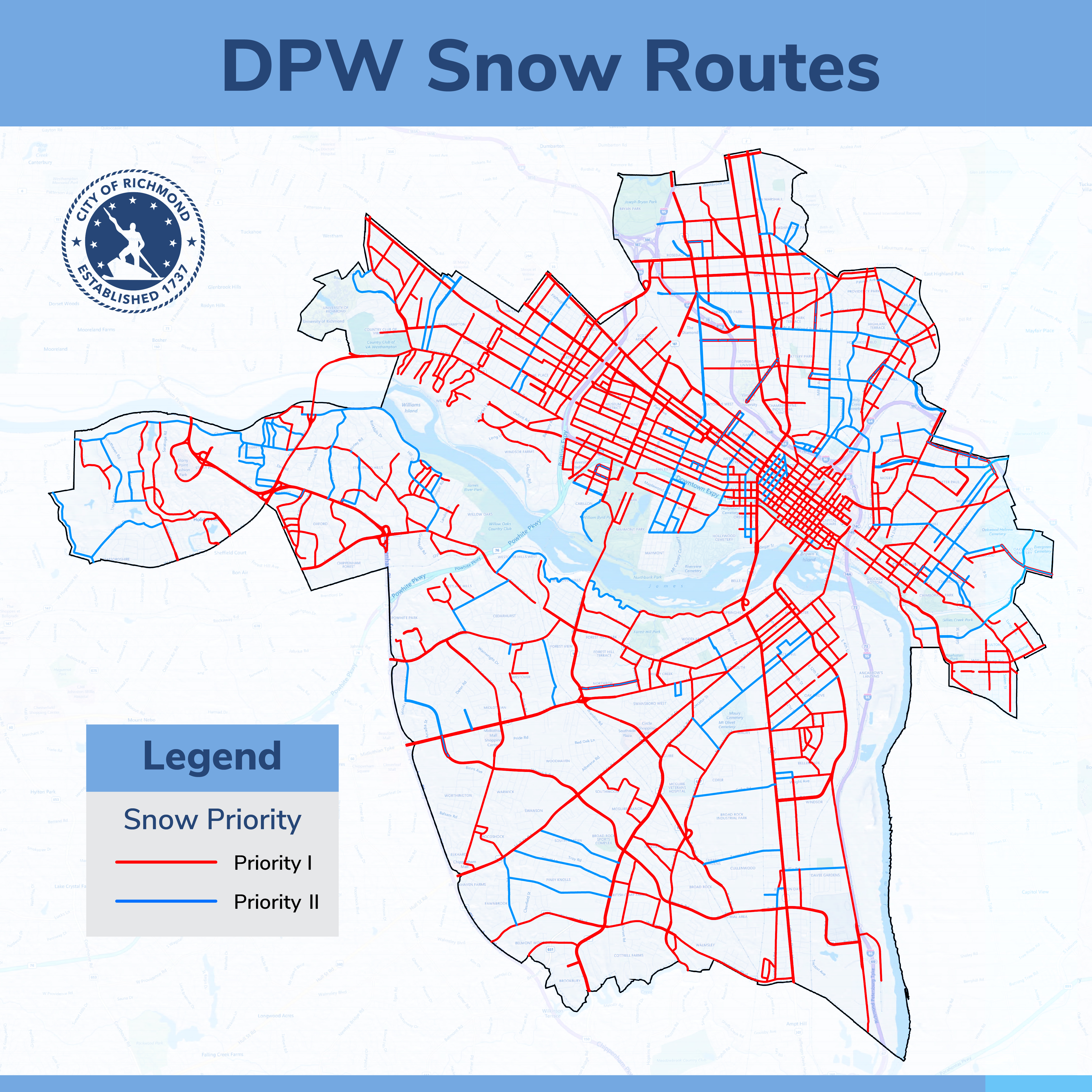
While the Virginia Department of Transportation handles some county thoroughfares, all Virginia cities are generally charged with maintaining their own roads. Removal crews take on Richmond’s streets through a set priority order to make sure that some of our most critical thoroughfares stay open for emergency vehicles.
Here’s how we set a priority order, knowing that accumulation and temperatures might change estimates:
Priority 1 Snow Routes (700 lane miles, or 28% of the city):
Major Arterial Roadways, bridges, ambulance station sites (coded in red on the map). The goal is for these major thoroughfares to reach close to bare pavement as soon as possible.
Priority 2 Snow Routes (200 lane miles, or 8% of the city):
Connector Streets (coded in blue on the map). The goal is for these roads to reach close to bare pavement within 24 hours after a snow event concludes.
Priority 3 Snow Routes (1600 lane miles, or 64% of the city):
Local neighborhood streets (not indicated on the map). Crews conduct treatment and removal only after first and second priority routes are completed. Plows typically reach neighborhoods within 48 to 72 hours after snowfall ends.
Because crews follow this set priority list to ensure that our most urgent community needs can be met, the City does not take individual snow removal requests through 311 or other platforms. You can find the full list of priority roads by route on the Winter Maintenance Plan.
Emergency Routes
The city has designated snow emergency routes to improve travel and snow removal along portions of certain major thoroughfares. The snow emergency routes include portions of:
- Broad Street
- 7th Street
- 8th Street
- Franklin Street
- Main Street
- Cary Street,
- Marshall Street
- Semmes Avenue
- Mechanicsville Turnpike
If the city leadership declares a snow emergency, parking will be illegal during times indicated on the new signs. The city will tow illegally parked vehicles (see “What do I do if my car is towed?” below).
How do you decide when to plow and when to treat?
Snow removal includes both the plowing we all might imagine first and the treatment of routes with salt, sand, and other chemicals.
Plowing is most useful when the total snow accumulation is above 2 inches. When the snowfall is less than 2 inches, or the accumulation is primarily ice, plow blades are not as effective.
Treating includes spreading salt, chemicals, or sand to the road. Salt and chemicals can speed up the melting process when the temperatures are above 20 degrees, and sand helps with traction on icy roads.
All removal crews have route supervisors who assess the removal process in real time. A route supervisor might notice that a side of a street is shadier or that they’re seeing more ice than was predicted in the forecast. They make real-time adjustments to the snow removal process to make sure that the most useful tools are on your street.
Our crews also pre-treat. Usually, the City starts to pre-treat roadways and overpasses 48 hours before the event. This gives us enough time to prepare while making sure that whatever we use will still be effective. Pre-treating usually involves a salt brine that sticks to the road best. Pre-treating works less well when there is rain—which washes the brine away—or when temperatures are below 20 degrees.
What about my driveway or parking lot? Plows blocked me in, or I need help getting through.
The City’s primary responsibility is to clear the travel way for emergency and other necessary services. Residents, property owners, and business owners have the responsibility to clear their own driveways, parking lots, and sidewalks.
When plows are working efficiently to clear the roadway, they aren’t able to stop at every driveway. That challenge can lead to some build up in front of individual driveways. During a winter event, please plan ahead by treating your own walkways and driveways.
How can I help?
Keeping our communities safe is a job for all of us:
- Yield to plows and don’t pass them. Plows have large blind spots, can stop abruptly, or may have a hard time breaking. Give them lots of room whether they’re pre-treating roads or clearing snow.
- Stay home if you can. Increased road traffic increases the risk of vehicle crashes and more emergency response needs.
- Plan your route carefully. If you have to travel, use the priority route list to take clearer roads to your destination.
- Try not to move snow from driveways and parking lots into City streets. Extra snow and ice coming into the streets can make it harder to clear those roadways.
- Clear your sidewalks. The sidewalks next to your property are the responsibility of the property owner or occupants. City Code requires sidewalks to be cleared within 6 hours of snow stopping or by 11 a.m. the next day if snow falls through the night.
- Plan ahead with street parking. If possible, park your car on side streets. Stay off major roads and especially emergency routes so that plows can get through, and avoid double parking.
What do I do if my car is towed?
If your car is towed by the City during a weather event, please contact Siebert’s Towing (642 W. Southside Plaza) at 804-233-5757. To find out if your vehicle is at Seibert’s:
- Go to: intow.seibertcos.com
- Enter your VIN or plate number to find out if your vehicle with Seibert's
- Note: there is a short lag time, but most vehicles should be in the system an hour or less from the time it was towed