

City News
Press Releases and Announcements
Richmond Elections: November 3 Election Information and Updates
Here's Everything You Need to Know
The Richmond Office of Elections is providing residents with a dedicated online resource for the upcoming November 3, 2026, General and Special Elections. Our November 3 Election webpage brings important election information together in one place, including key dates and deadlines, early voting details, sample ballots, ballot questions, and voter resources.
Stay updated: Residents are encouraged to review the November 3 Election page and check back regularly for election-related updates.
November 3 Election Information
Visit the November 3 Election webpage for election-specific information, including deadlines, voting options, sample ballots, and updates.
Register or Update Your Information
Eligible residents can register to vote, check their registration status, or update their voter information through our Voter Registration page.
📍 Early Voting
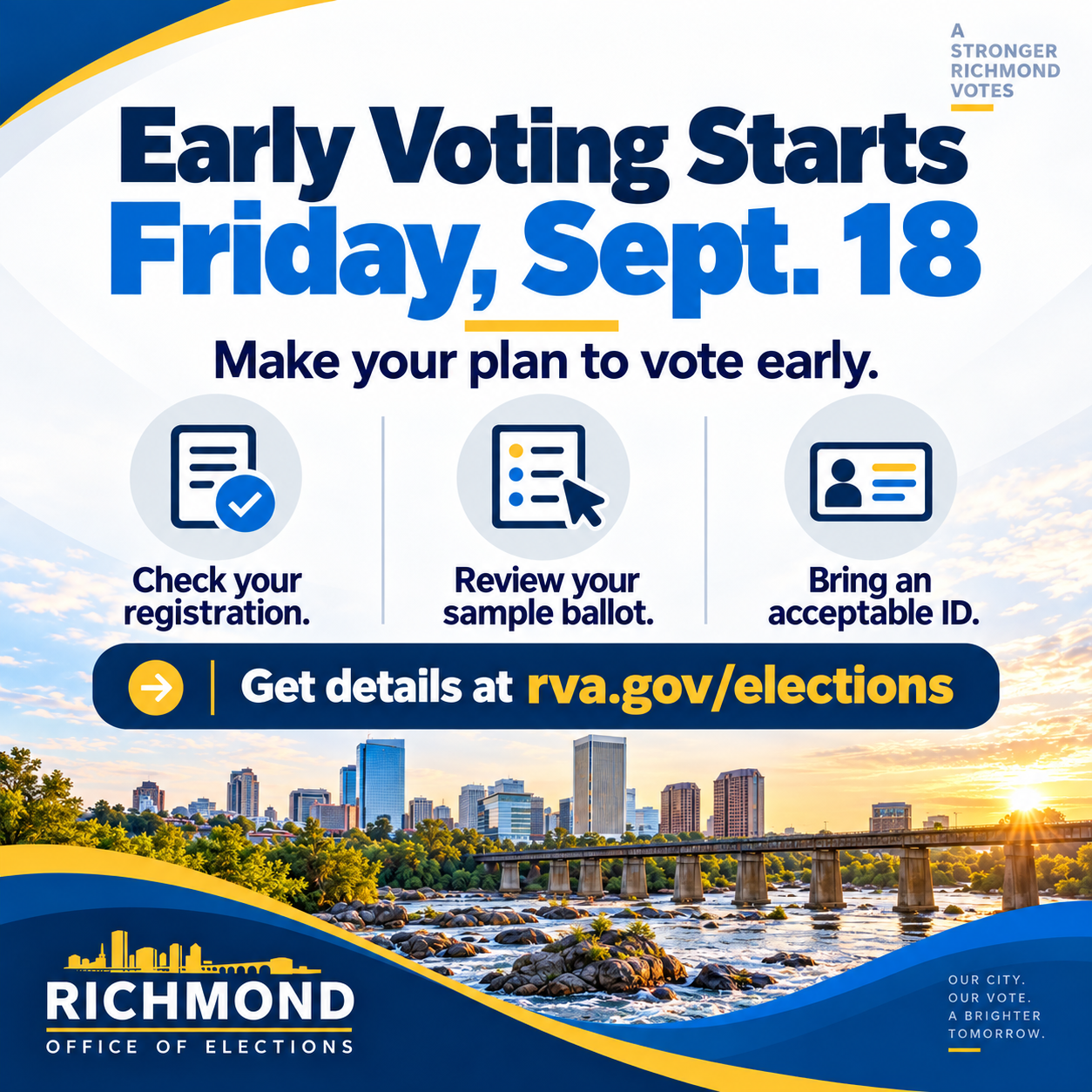
Early voting begins tomorrow, Friday, September 18 at the Richmond Office of Elections on Laburnum Avenue. Additional early voting locations at City Hall and Hickory Hill will open on October 18.
For dates, hours, locations, and additional details, visit the November 3 Election page.
🎓 Information for College Students
College students can find information tailored to their needs, including voter registration guidance, residential address information, and other helpful resources.
Visit the Voter Registration page and view the College Students section for more information.
📣 Stay Connected for Election Updates
The Richmond Office of Elections will continue sharing election information, reminders, and updates through our official channels.
Questions? Contact the Richmond Office of Elections at (804) 646-5950 or vote@rva.gov.
City of Richmond Announces Key Appointments to Advance Public Housing Transformation
Expert staff to oversee implementation of Gilpin Court Redevelopment as outlined in Jackson Ward Community Plan
Richmond, VA — The City of Richmond is pleased to announce the appointment of Kevin Marchman and Edward P. Richards to step into the roles of Senior Advisor for Public Housing Transformation and People Plan Program Manager, respectively.
Kevin Marchman joins the City from the National Organization of African Americans in Housing (NOAAH), a national advocacy organization which he founded in 1998 to advance equitable housing policies and resident empowerment initiatives. At NOAAH, he served as Executive Director, Managing Director and Board Chairperson.
In addition to his nearly three decades at the helm of NOAAH, Mr. Marchman has served as a Deputy Assistant Secretary and Assistant Secretary in the U.S. Department of Housing and Urban Development, Executive Director of the Denver Housing Authority, and as Deputy Chief of Staff in the Office of the Mayor for the City of Denver.
“We are incredibly fortunate to welcome Kevin to Team Richmond,” said Mayor Danny Avula. “In him, we have a tried and tested leader with a deep commitment to and expertise in public housing and community development. I cannot imagine a more qualified professional to facilitate our public housing transformation and look forward to learning from him and working with him to reimagine and reinvigorate our public housing communities, starting with Gilpin.”
Mr. Marchman steps into a newly created position for the City, providing strategic direction over the transformation of large-scale public housing developments and their surrounding neighborhoods, in close partnership with the Richmond Redevelopment and Housing Authority (RRHA).
Edward Richards joins the City’s Office of Community Wealth Building having spent more than a decade serving Richmond’s most vulnerable residents as a Social Worker, providing support to older adults, persons experiencing homelessness, people with intellectual disabilities, the medically vulnerable, refugees, and low-income communities.
He is a graduate of VCU’s School of Social Work, where he now teaches as an adjunct professor. In addition to his work at VCU and as a Community Embedded (Adjunct) Faculty, Mr. Richards also volunteers time as the Membership Committee Chair for the Richmond Association of Black Social Workers and serves on the board of the Uplift Community Action (formerly Capital Area Partnership Uplifting People – CAPUP). He has also worked as a Community Advisory member for Henrico County and the City of Richmond’s Health Equity Fund.
As the People Plan Program Manager, Mr. Richards will oversee the people plan for Gilpin Court, supporting residents through economic mobility by offering family assessments and case management, coordination with community partners to provide support services and job training and job placements, all while continuing to communicate and collaborate with residents to ensure successful outcomes.
Mr. Richards will work closely with RRHA, service providers, and internal City partners to reduce barriers throughout the housing transition, develop a coordinated system of partners, strengthen case management programming, and promote long-term housing stability during and after relocation.
“For the City to truly transform, we have to transform public housing” said Sharon Ebert, Deputy Chief Administrative Officer for Planning and Economic Development, which includes the Office of Community Wealth Building. “That process starts with getting the right people in position; people who are committed to the work of understanding the needs and desires of people with limited incomes. Mr. Richards is one of these people, and we are lucky to have him on board.”
In the short-term, both Mr. Marchman and Mr. Richards will be deeply involved in implementing the redevelopment of Gilpin Court, as part of the larger Jackson Ward Community Plan (JWCP) and in collaboration with the Richmond Redevelopment and Housing Authority and the Joint Gilpin Transformation Working Group, which includes senior staff from both the City and RRHA.
The hiring of both Mr. Marchman and Mr. Richards is consistent with the key terms outlined in the Gilpin Court redevelopment memorandum of understanding, currently before the City Council for approval, that calls for the hiring of full-time City staff to oversee implementation of the JWCP’s three core elements: Neighborhood, Housing, and People.
###
About the Jackson Ward Community Plan
The Jackson Ward Community Plan brought Gilpin Court and Jackson Ward residents, planning experts, elected officials, and community members together to reach an informed, shared vision for the future of the neighborhood.
The final plan was submitted to the United States Department of Housing and Urban Development (HUD) November 17, 2023, and approved by HUD in August 2024. The Jackson Ward business community and residents requested additional work be done to the plan in 2025 and a soon to be released final version should be available in October.
Richmond People’s Budget and GRTC Celebrate Completion of Bus Shelter with Jackson Ward/Carver Ride Along
The City of Richmond will celebrate a major People’s Budget and GRTC milestone with a community ride-along and dedication for the Lombardy/Kroger bus shelter.
This project is:
- The first shelter completed by People’s Budget Cycle One
- The 90th shelter installed through GRTC’s Essential Transit Infrastructure (ETI) program
- A significant achievement for resident‑driven investment across the City
The community‑selected shelter, a $50,000 project, was one of the top‑voted priorities in 2nd District, with nearly half of all district participants supporting its installation.
"This shelter demonstrates how public infrastructure can reflect community priorities when residents are empowered to shape the City's investment decisions," said Jerome Legions, Richmond People's Budget founding Steering Commission member. "The People's Budget process ensures voices from every neighborhood directly influence improvements that matter."
“Partnership has been critical to advancing bus stop improvements across our system,” said Adrienne Torres, GRTC Chief of Staff and Chief Development Officer. “Support from the City, our regional partners and the Commonwealth, including legislation passed in 2024, has helped strengthen the framework for investing in essential transit infrastructure and improving access for our riders.”
The stop serves riders traveling toward Laburnum, Chamberlayne, and Westbrook corridors, strengthening a key connector between the 2nd and 3rd Districts.
This project also supports the Department of Public Works’ Vision Zero Action Plan, which aims to reduce traffic fatalities to zero by 2030. Buses are a critical part of achieving this goal because they offer a safer way to travel.
"The budget is a joint plan between the community, elected officials, and staff," said Chief Administrative Officer Odie Donald II. "This shelter is a powerful example of what can be accomplished when those partners align on the planning, transparency, and commitment necessary to get projects done for the betterment of Richmond."
"What excites me most about this is seeing Richmond’s commitment to listening to residents and investing in their priorities come to life in a project that people can see, use, and enjoy,” said Councilmember Katherine Jordan. "I'm extremely grateful for all of the folks that gave their time and energy"
Event Details
September 15, 2026 | 5:00 – 6:30 PM
Ride‑along on GRTC Route, beginning at City Hall and concluding at the Lombardy Kroger shelter
Schedule
5:15 PM – Check‑in at City Hall
5:30 PM – Board bus; rolling Q&A
5:55 PM – Arrive at shelter
6:00 PM – Remarks and placement of People’s Budget Completion Badge; cupcakes
6:20 PM – Return to City Hall
Media may interview project champions, People’s Budget Steering Commission members, City Council representatives, Office of Community Engagement staff, the Chief Administrative Officer, and GRTC personnel.
Photos and video of the badge placement will be available.
Residents can learn more about People’s Budget Cycle One, including project updates at rvapb.org. To stay current and learn more about how to participate in the People’s Budget, subscribe to "The People’s Purse" newsletter.
About the Richmond People’s Budget
The Richmond People’s Budget is the City’s participatory budgeting program, allowing residents to propose and vote on capital improvements in their neighborhoods. Cycle One concluded in May 2025 with 33 funded projects across the city. Beginning in July 2026, the People’s Budget program became a part of the Chief Administrative Officer’s new Community Engagement initiative, which works across city government to create more transparent, accessible, and resident‑centered pathways for civic participation.
About GRTC’s Essential Transit Infrastructure (ETI) Program
Launched in 2022, ETI improves accessibility, safety, comfort, and dignity at bus stops through shelters, benches, ADA‑accessible landing pads, lighting, and other amenities.
Media Contact:
Monica Annette Manney
Public Information Manager, Office of the Chief Administrative Officer
Email: monica.manney@rva.gov
Mayor Danny Avula's Statement on NextEra Energy and Dominion Energy's Sep 14, 2026 announcement
Today, Mayor Danny Avula provided this statement on NextEra Energy and Dominion Energy's announcement about Virginia's benefits package:
"The news we're hearing today is encouraging and it’s the exact reason the city has filed as a respondent in the case before the State Corporation Commission. Dominion/NextEra are proposing to invest in Richmond. If delivered on, these are important potential next steps—a new downtown tower, a commitment to preserve jobs and add new jobs here, large investments in the workforce development pipeline, and a greater rebate commitment to the residential ratepayers of Virginia.
Ratepayers, especially vulnerable ratepayers, our local workforce, and our capital city need to be represented in this process.
We will be actively monitoring the process, and will continue to champion the needs of Richmonders."
On August 10, 2026, Mayor Avula, along with City Council members President Cynthia Newbille, Vice President Katherine Jordan, Andrew Breton, Ellen Robertson, and Stephanie Lynch, introduce Res. No. 2026-R034 to approve the City's participation to formally intervene in the State Corporation Case involving Dominion Energy.
Elections: Logic & Accuracy (L&A) Testing
The Electoral Board will conduct Logic & Accuracy (L&A) testing of voting equipment in preparation for the upcoming election.
Logic & Accuracy testing is a public process used to verify that voting equipment is properly programmed and accurately records and tabulates votes as expected before ballots are cast.
Testing Details
Date: Wednesday, September 16th, 2026
Time: 11:00 a.m.
Location: 1st Floor Tech Center, 2134 W. Laburnum Avenue, Richmond, Virginia 23227
Pursuant to the applicable provisions of the Code of Virginia, the City of Richmond Electoral Board will conduct Logic and Accuracy (L&A) testing of voting equipment prior to the election.
Public Attendance: Members of the public may attend the L&A testing only if they present a physical letter of authorization from their respective political party chair. The letter must be provided upon arrival and will be required for admission to the testing.
Or search using "Type it, find it" above
Pinned
Most Recent
Or search using "Type it, find it" above